Thursday, January 28, 2016

Brigita’s Dream


“Then I feltand even saw in the wavesmy energy body, which I believed to be my very being, move away from me and merge with the energy bodiesthe very beingof the pigs. I felt, saw and knew in that instant that the pigs and Idespite our radical difference, our complete alteritywere interconnected, so deeply interconnected that we were one continuous being.”
––Bob Comis “’The pigs were glowing deep gold’: The amazing experience that ended my life as a pig famer”

A good friend of mine, let’s call her Brigita, spent a night in my guest room. The next morning, over a cup of hot tea in my kitchen, she told me of the dream she had while sleeping between my clean sheets.

In her dream, Brigita was in a room crowded with men. At one point she found herself leaning back on a bed. In another, she sat between two of them on a large sofa. “One,” she said blushing, “was quite handsome.” It seemed to me, however, she had enjoyed flirting with both. “I felt sure I would kiss at least one of them,” she admitted somewhat shyly. You see, Brigita was widowed several years ago and, as far as I know, rarely dated.

“But here’s where it gets strange,” she said, tapping my forearm with the pads of her fingertips, warm and wet from her steamy cup. “I was also aware of a presence bigger than anyone else in that room. Let’s say it was the voice of God joining me while I sat there waiting for one of the men to reach out.”

She addressed the God voice indignantly as if it was already criticizing her. “Well, Why shouldn't I kiss them? I mean, they’re here, so many of them, and I want to!”

The voice responded with silence, and in the very next moment, Brigita and the handsome one began necking, sitting side-by-side on the couch. His tongue in her mouth, hers in his, which, she told me, was just as pleasant as she recalled.

Then the pleasant sensations became distorted. First, she noticed an odd and smoky taste. “A very meaty flavor,” she said, “which could only originate from his mouth. Yet, as unpleasant as it was, all I cared about was whether or not he enjoyed my kisses. Am I pleasing him? Do I still have the proper technique? I wondered” The more she wondered, the odder the taste until it became intolerable. She pushed him away and stood some distance from where the men in the room clustered and chatted.

But the unpleasant taste grew stronger still. “Actually, it became even more disgusting!” she said. “Gritty strands of meat clung to my teeth. I tried spitting them out, but no matter how much I spat, there were always more.” She discovered a chunk of salami under her tongue, little slices of pepperoni stored in her cheeks. To her growing alarm, as soon as she expelled one meaty chunk, another appeared. Sausages she’d unknowingly been storing in the back corners of her mouth for years made their way to the tip of her tongue.

She grew nauseous, and it seemed to her the room of men began to spin. “What's going on?” Brigita called out to God. The answer came to her as clear as a bell, “I am purifying you.”

She put her cup to lips and studied my face across its rim. “You see,” she told me. “I now understand our bodies are energy. When we kiss someone or have sexual relations there’s a karmic exchange.”

I must have looked upon her skeptically because she arched her own eyebrow in response.

Silently, I began doing my own calculations. With whom and how many have I shared a bed? I sipped tea in some urgency, for the power of suggestion had implanted a smoky taste across my own tongue.

“I’m not judging you,” she insisted. “It’s mathematical truth.”

She returned to what she had seen in her dream. Some of the men began fornicating with each other, and some with women who had appeared from nowhere naked and open-legged. “There were golden lines of energy winding through and away from each body,” she said, which entangled with one another like loose threads unwinding from multiple balls of yarn. “There was something beautiful about it, yes, but also inescapable. When I think of the men I’ve been with. All the purifying I must now endure!”

“But Brigita,” I said, “you live the life of a nun!” You see, she had been blameless in her husband’s death. Throughout his long illness his family had sometimes called her a saint.

She sighed. “You don’t understand. Before I was married. Well, after too––” She drank again from her cup. Her gaze softening, she looked past me and into the other room. “The thing is, I noticed God wasn’t purifying anyone on my behalf. No one else was being prepared. I had attitude about that! Why no man for me? I called out. But, no, God was quite firm. I am the one in need of purification! That much was clear.”

I swirled a bit of tea across my tongue. I put the cup down and added more honey, using Brigita’s spoon. I looked across the table at my friend, sitting in her nightgown, with uncombed hair. There was nothing more beautiful to me than this woman whose face was plumper than in our youth, holding her cup with brown and wrinkled hands, looking upon me with sweet and glittering eyes.

How pure was it possible for one woman to become, and how can anyone ever argue with a dream?


Sunday, January 10, 2016

Beauty and Celebration: The San Benito County Jail Book Project


“Though it was at my heart’s bidding that I chose the universe wherein I delight, I at least have the power of finding therein the many meanings I wish to find: there is a close relationship between flowers and convicts.”––The Thief’s Journal, Jean Genet

The project took many hours. We spoke often of our subjects: addiction and sobriety in one group; struggle in another; love, in the third. Golf pencils in hand, writers approached their pages in monastic silence, writing quickly to stay ahead of inner censors. Let poor spelling not stop us, we cried. Let our pencils take us where they will.

Surprised and inspired by what paper and pencil had power to produce, some carried fresh sheets back to their cells in manila folders with author’s names delicately rendered in gothic lettering, while pencils, which were allowed but rationed, were tucked away in elastic waistband or bra awaiting additional discovery and expression.

Each week people returned to our classroom with new poems, small essays too, hand-written in partnership with cellmates. Artists created images to match the words: broken hearts; skeletal women; a fairy lifting off from a tender blade of grass. The work reached ever outward to explain something to someone but what and to whom? The condition of souls? Incarceration––its distinct qualities and sounds? The meaning of love, its illusions, traps, and ability to liberate and redeem? Who would listen?

My job was to facilitate discussion, lead us into writing, and gather the results. I’d arrive back at my office on a small community college campus in rural California with folders full of poems, stories, and drawings meant to accompany them. I then scanned the artwork, typed others' words into my computer, and began to design a sequence to best showcase the passion and intensity of our classroom experience.

The following week, I’d return to the jail with crisp, printed versions of what we’d produced. Is this what you wanted? I asked. Is this how the stanzas should flow?

Yes and no and maybe.

When possible, pieces were reworked. When not, they weren’t. Some writers we saw only once. They came to the room, wrote with us, and were released before a next class meeting, a few unedited lines the only physical sign of the time we shared.

As a final deadline drew near, the work came in a rush. Last minute flashes of inspiration led to book titles to which everyone suddenly and immediately agreed. That’s good! That’s good! we said. It took hours to type up new pieces, to print out and proofread, and printout once again. But what relief there was in meeting a deadline––the strange peace experienced when something is dropped off for a printing.

In the pods, perhaps they were sleeping or carrying on with ever more writing. As for me, I sat in my home watching a very pretty documentary, Dior and I, which tracked the creation of a designer’s first couture collection. That man, Raf Simons, had a tight deadline, a dedicated crew of artisan assistants, and millions of dollars with which to play.

Simons studied what inspired his predecessor and the subtle repetitions and trashed elegance of modern art, directing this aesthetic to the creation of new prints and surprisingly simple sketches, which he delivered to the ateliers responsible for turning sketches into realities.

In and out of workrooms flew the garments, hand sewn muslin prototypes draped over stuffed mannequins until just the right shapes were formed. A Dior trained international army of artisans approached their work as if the pieces they fashioned were sacred, and to me, encased in my own haze of creative release, it seemed possible they were.

Light-as-air skirts of impossible volumes required hundreds of small folds be carefully stitched into place. Late into the night, a dozen hands sewed beads on to bodices, so the next morning a long girl with a golden ponytail could stride across a showroom and Simons, the designer, could tell the artisans exactly where they’d gone wrong.

It was he that chose the backdrop for the unveiling of his collection––a once fine Parisian apartment in a wealthy district. It rooms were in disarray. But here would sit the wealthy and fashionable people for whose critical gaze Simons created his collection.

Would the already well-explored aesthetic of chipped paint and scratched floors be celebrated or dismissed when juxtaposed against Simons’ precise and polished pieces? He studied the apartment anxiously––its appealing shape and marble staircase. From here he somehow recalled Dior’s gardens and artist Jeff Koon’s giant sculptures rendered in living plants. Why not cover the walls in fresh blossoms? He wondered, and because he thought it, it was done!

After a frenzied 48 hours, dense walls of white orchids reached from floor to ceiling in one room, roses in another, delphiniums in a third––their fresh blossoms heavily scenting the air.

A younger me would have stood in judgment of the extravagance, pondering all the mouths that could have been fed with the cost of all the flowers alone. But that night I saw something different––connection! What teamwork!

How very human it is to want to create beauty, no matter the cost! We make excuses to do it, form communities, expend great resources, while also establishing entire hierarchical structures, ranking systems, etc... in order to judge our efforts and inspire the making of more and more beauty, so deeply do we long for it in new forms.

I couldn't help but look at Simons, all the busy laborers he employed––the seamstresses, publicity men, models lined against a wall waiting stoically––and think to myself, but it’s just like jail! I mean, the jail I teach in, the incarcerated writers I work with, my college, me, the woman who ran the copy machines that brought our books to life, so I could return to the classroom with separate editions for each pod and host a book release party on the last day of the term. That party was our runway.

It was a stupendous experience, our show. We shared it with the jail commander, the college’s vice president, the program director who brought college classes to jail, and all the contributing writers and artists who were still behind bars the day of our book party.

The three books contain fragmented stories, many poems, and a few illustrations rendered in the weak lead afforded by jail-approved golf pencils. The work is based on the lives of the incarcerated people of San Benito County in Hollister, California, a rotating team who found themselves together for at least one hour, and some for many more, in the fall of 2015.

We’ve distributed our titles to the discerning eyes of our colleagues, other writers, family members, friends, acquaintances, and now to you should you click on the links below. We hope you find beauty in our creation:


Monday, August 24, 2015

Items of the Dead


“Head tells heart how it is, again:
You will lose the ones you love. They will all go. But even the earth will go someday.”
––Lydia Davis, “Head, Heart”


Simone called in tears because an eye-glass case once belonging to her father, the one she inherited upon his death, fell from a coat pocket and was lost on a New York City street.

“It’s not the case you’re mourning,” I told her. “You want your father back. You can buy another case.”

She sighed and said they used to fight over the one she’d lost because she longed for it before he was ready to give it away, a thin black sleeve of leather he used to roll between his big fingers. It was masculine and soft, like his skin, Simone said, and worn in the exact manner she prefers––a cracked patina she associates with valuable objects, things that cost dearly years ago, and cannot be easily replaced. So different than things made in the digital era where value is created through surfaces that are voids––blank and shiny and clean.

“Yes,” I said. “I understand. Our fathers will not return.”

I grew up in a family less wealthy than hers, but by today’s standards, even hers was not very wealthy. They were not of the one percent who demand entire sections of cities be reconfigured in their honor, purchasing penthouse suites in towers rising past clouds with special glass for looking out of but not for looking in. Simone’s family was not that, but they did have fine things––Turkish carpets and candelabras shipped from Austria ahead of the Nazis, who took everything they left behind, including family members unable to make a timely escape.

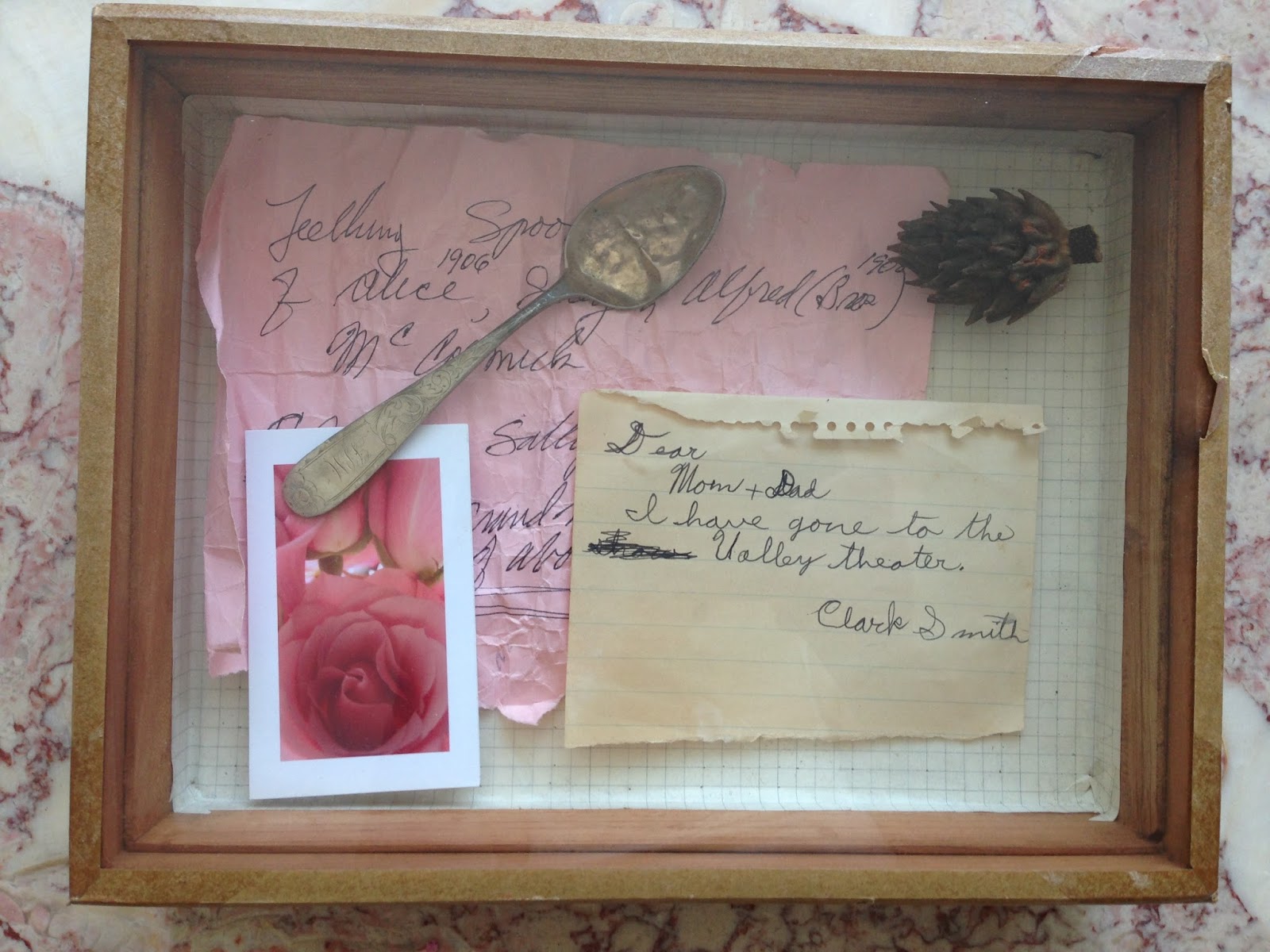
What I have is my West-Virginian grandmother’s silver teething spoon. Her initials are engraved on its handle and its hollow is worn thin and bent like wrinkled cloth, signs, presumably, my grandmother did, indeed, gum it as a toddler. Now I use it to stir sugar into tea I serve guests.

From my other grandmother––the cranky one––I have a cracked blue soap dish with two white birds perched at the edge. There’s a blackened seam of glue holding it together, and sometimes it re-splits. Every so often, I must put a fresh line of Elmer’s across the old break to make it whole again. This very soap dish, already damaged, sat in my grandmother’s front bathroom years before her death.

Until then, I hadn’t even known I noticed it. However, once grandmother was gone, we were allowed to choose things we wanted to remember her by, and I chose the dish because of its familiarity, so familiar it had hardly been seen––also a small pink hippo. The hippo, formed from a strange plastic no longer in use, sits on a ledge over my kitchen sink, just as it once did over hers.

Not long ago, Mother was throwing away the ugliest thing, a grey canvas lap-top bag that belonged years ago to my father. It’s worn, and not in the beautiful way Simone desires. I nevertheless suddenly coveted it. After all, it once belonged to my father, whose death three years ago is one I’m still getting used to.

I plucked it from the pile of things Mother was tossing. Though it is small, heavy, and impractical, I tried carrying my laptop in it. But the bag is not my father. It is ugly and grey, something I never even saw him use. Still, I can imagine him purchasing it with pride. Like me, he had ambitions––grand intellectual projects––bigger and grander than his small world of family and this ugly impractical grey bag could sustain.

I imagine him buying it and placing his laptop in it much like I did mine. What hope it would have carried! But where was he going to go with his laptop? My sister had childhood cancer and had suffered significant brain damage after the surgery. She needed full-time care. As a result for thirty years, my father and mother rarely left the house.

There are diamond rings that belonged to my great-grandmothers, and one or two now belong to me. I never wear them. They are for more slender fingers, and I’m wary of diamonds. They seem fancy and are less than interesting because they are the very things we are meant to value when someone dies.

What I like are the everyday objects the dead once used––things familiar or banal that can be loaded up with a variety of memories (real or imagined). We can imbue them with so much story they seem to reveal the dead to us in a present-tense manner out of all proportion to an object’s actual use in our present-tense lives and, perhaps, even out of all proportion to the role they played in the actual lives of those now dead.

For memorializing a loved one, I recommend choosing not the diamond, the gold watch, nor the pricey porcelain vase but instead the well-worn comb, bathrobe, or jelly jar holding an abandoned collection of loose buttons or old coins. But be prepared, should one of these objects go missing, the ache of its absence will surprise you; you will know the value of comb, bathrobe, and jelly-jar in a fresh and painful way. In losing even these small things, you will find the dead can die all over again.